Features Modules Who It's For Integrations FAQ Book a Demo
Purpose-built for higher education

The scheduling platform
that thinks like a registrar

CampusWorkflow gives registrars, faculty coordinators, and institutional leadership a single system — constraint-aware scheduling, attendance, demand planning, room management, and analytics built for the real complexity of higher education.

8+
Integrated modules
Multi-campus
Multi-tenant ready
FERPA
Compliant by design
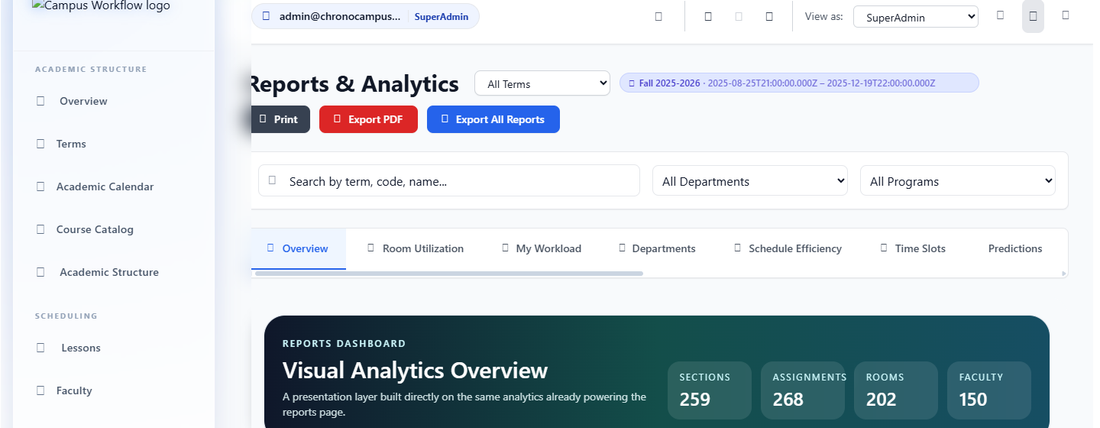
Reports Dashboard
Visual Analytics Overview
Sections
1,240
Faculty
480
Rooms
140
Efficiency
100%
0 conflicts
Room Util.
74%
140 rooms
Scheduled
1,219
of 1,240 total
Section Status
Teaching load distribution
1,240
Scheduled1,219
Draft21
View all 1,240 sections →
Faculty Workload
Load balance distribution
480
Balanced380
Underutil.95
Overloaded5
View all 480 faculty →
How It Works

Up and running in days, not months

CampusWorkflow is configured for your institution's structure — no multi-year implementation, no consultants required.

1

Onboard your institution

We configure your tenant with your academic calendar, departments, room inventory, and role structure. SSO is wired to your identity provider from day one.

2

Run your first scheduling cycle

Faculty submit preferences, coordinators define constraints, and the scheduling engine generates a conflict-free timetable. Readiness gates ensure nothing is published until it's ready.

3

Operate and improve every term

Analytics close the loop — room utilization, demand accuracy, faculty satisfaction, and SLA compliance give you the data to make better decisions every cycle.

Platform Modules

Every function academic operations requires

Eight deeply integrated modules covering the full academic lifecycle — from the moment a student expresses interest in a course to the day their degree audit is complete.

Intelligent Scheduling

Constraint-aware auto-scheduling engine that detects and resolves room, faculty, and time conflicts before they reach the timetable. Optimizes for room utilization and faculty workload simultaneously.

Conflict Detection Auto-Optimization Multi-constraint

Flexible Class Patterns

Supports recurring, date-specific, hybrid, and irregular class patterns. Handles holiday and blocked-date exceptions, academic calendar overrides, and exam scheduling windows without manual workarounds.

Recurring Rules Holiday Handling Hybrid Support

Attendance & Early Alerts

QR code and manual attendance capture with real-time dashboards for students, faculty, and the registrar. At-risk student flags based on attendance thresholds, with actionable intervention reporting.

QR Capture At-Risk Flags Registrar View

Pre-Registration Demand Planning

Students indicate intended courses and seat preferences before registration opens. Admins see real demand per section before building the timetable — eliminating underfilled sections and capacity mismatches.

Demand Signals Advisor Flags Confidence Scoring

Advanced Calendar & Planning Views

Calendar, timeline, and heatmap views with grouping by room, faculty, department, and student group. Designed for large institutions managing hundreds of sections across multiple buildings.

Heatmap View Group Filters Timeline Mode

Analytics & KPI Dashboards

Institutional dashboards covering scheduling progress, room utilization, faculty workload distribution, conflict trend analysis, and pre-registration demand confidence — built for operational decision-making.

Room KPIs Faculty Load Conflict Trends

Room, Equipment & Maintenance

Room booking engine with equipment inventory, maintenance block scheduling, and capacity management. Maintenance windows automatically propagate into the scheduling engine to prevent invalid assignments.

Booking Engine Equipment Requests Maintenance Blocks

Multi-Tenant Enterprise

Multi-campus and multi-institution deployment. Owner-level oversight with per-tenant audit logs, API key management, module activation controls, usage reporting, and integration health monitoring.

Multi-Campus Audit Logs API Keys

Petitions & Approvals

Configurable petition workflows with multi-step routing, SLA enforcement, auto-escalation, and an appeals lifecycle. Full audit trail with AI-assisted routing suggestions for registrar teams.

SLA Enforcement Appeals Flow AI Routing
Scheduling Engine

Scheduling built for real academic complexity

Most timetable tools assume a clean, uniform schedule. CampusWorkflow handles the exception-heavy reality: back-to-back faculty constraints, shared labs, room type requirements, linked sections, and campus-wide blackout dates — resolved before the schedule is published.

  • Constraint-aware engine checks room capacity, faculty availability, and time overlaps simultaneously
  • Linked section support for lectures, labs, and tutorials with group assignment
  • Faculty preference collection pipeline with satisfaction scoring and override governance
  • Scheduling governance phases with readiness gates that block advancement until prerequisites are met
  • Simulation mode — run what-if scenarios before committing changes to the live timetable
  • Control tower view: phases, pending requests, SLA timers, and conflict queue in one dashboard
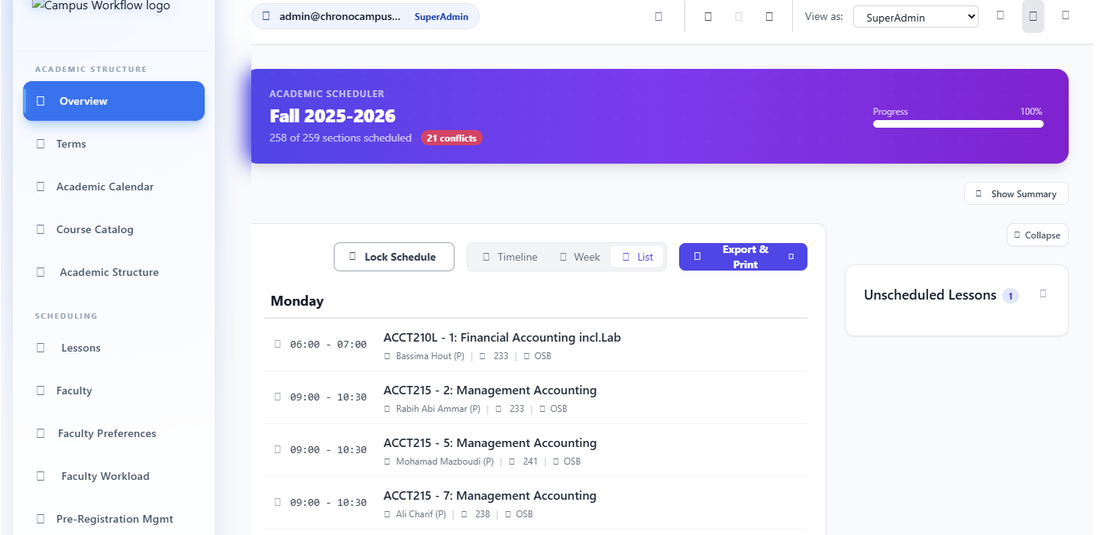
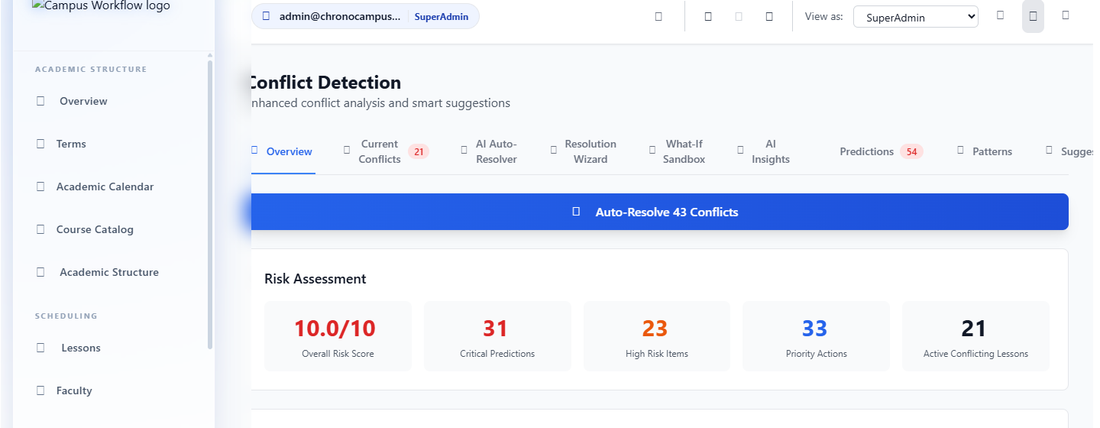
CampusWorkflow Scheduling Control Tower — AI Course Optimization
Attendance & Early Alerts

From attendance capture to early intervention

Attendance data is only valuable if it drives action. CampusWorkflow connects session-level QR capture to at-risk dashboards for faculty advisors and registrar staff — enabling early intervention before a student reaches the drop threshold.

  • QR code and manual attendance capture per session
  • Real-time student attendance portal with individual session history
  • Faculty dashboard: section-level attendance rates with trend lines
  • Registrar view: cross-department at-risk report with filter by threshold
  • Configurable alert thresholds per course, department, or institution-wide policy
  • Attendance data feeds into advisor flags and pre-registration planning
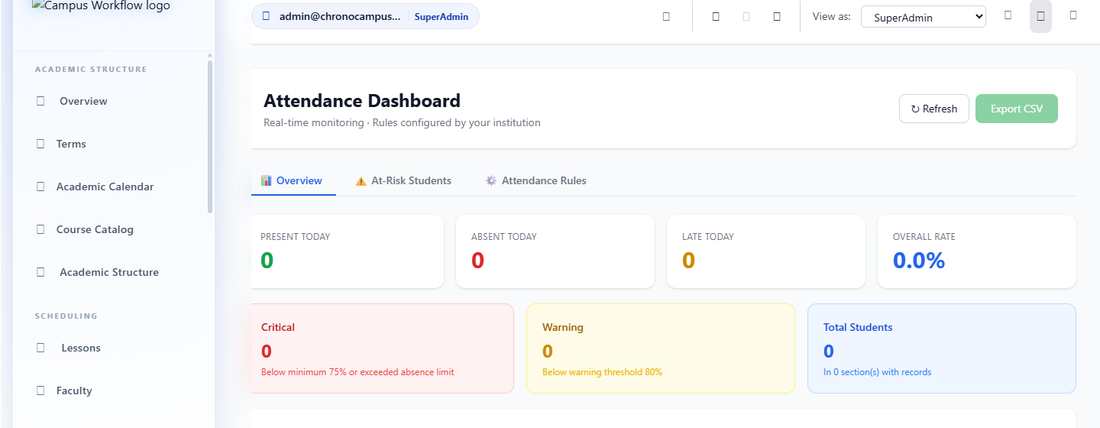
CampusWorkflow Attendance Dashboard
Pre-Registration

Demand visibility before registration opens

Pre-registration gives planning teams a demand signal weeks before registration opens. Rather than guessing how many sections to schedule, coordinators see confirmed interest broken down by program, year, and student group.

  • Students indicate intended courses and seat type preferences (on-campus, online, hybrid)
  • Demand aggregation per course, section, and program cohort
  • Confidence scoring: high/medium/low based on historical conversion rates
  • Advisor checkpoint flags: overload, prerequisite gaps, and progression risk
  • Feeds directly into the scheduling engine's section planning inputs
  • Capacity vs demand gap analysis before timetable is built
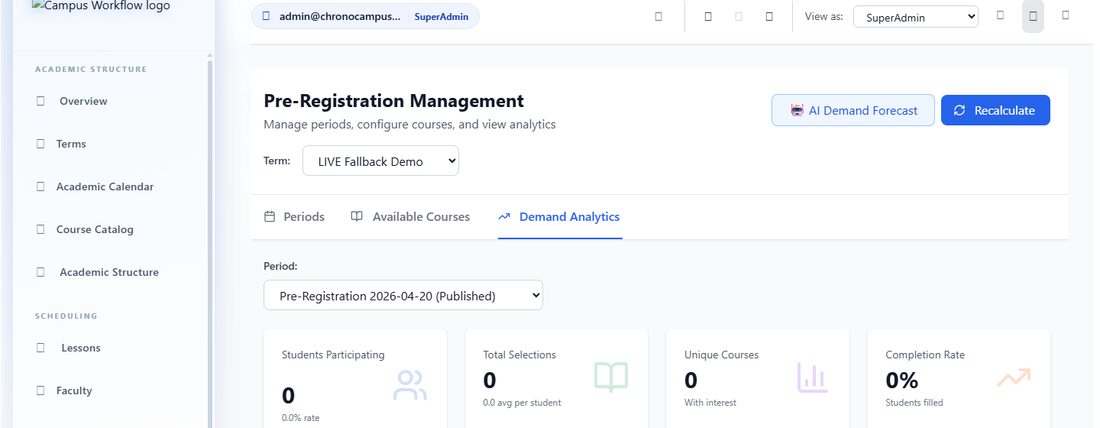
CampusWorkflow Pre-Registration Demand Planning
Role-Based Access

Built for every stakeholder in academic operations

CampusWorkflow surfaces the right information to each role — without giving anyone access they shouldn't have.

Registrar & Scheduling Office

  • Full scheduling workflow control
  • Phase governance and readiness gates
  • Conflict queue and SLA tracking
  • Petition and appeal management
  • Enrollment and drop/withdrawal reports
  • Cross-department demand analytics

Faculty

  • Submit and update scheduling preferences
  • View preference satisfaction and override reasons
  • QR attendance management per session
  • At-risk student visibility for advisors
  • Section evaluation management
  • Course evaluation schedule and results

Students

  • Pre-registration course interest submission
  • Personal schedule and calendar view
  • Attendance history per session
  • Petition submission and status tracking
  • Degree progress and requirement audit
  • Course evaluation participation

Leadership & IT

  • Executive planning dashboard
  • Institution-wide KPI snapshots
  • Multi-tenant and multi-campus oversight
  • API key management and integrations monitor
  • Full audit trail and FERPA access logs
  • SSO/SAML, RBAC, and tenant suspension controls
Analytics

Operational intelligence for decision-makers

CampusWorkflow's analytics layer is built for registrars and institutional leadership who need to make fast, data-backed decisions during the scheduling cycle — not just end-of-term reports.

  • Room utilization heatmaps by building, department, and time block
  • Faculty workload distribution with burnout-risk indicators
  • Scheduling conflict trend analysis across terms
  • Pre-registration demand vs actual enrollment conversion rates
  • SLA compliance rates per module (petitions, scheduling requests, admissions)
  • Executive planning dashboard: enrollment forecast, section profitability, and progression bottlenecks
KPI Snapshot · Fall 2025
74%
Avg Room Utilization
91%
Preference Satisfaction
12
Conflicts Resolved
98%
SLA Compliance
Faculty Load Distribution
85%
70%
Security & Compliance

Enterprise security, out of the box

Higher education institutions handle sensitive student records. CampusWorkflow is built with FERPA compliance, data isolation, and audit accountability as first-class requirements.

FERPA-Aware Access Logging

Every access to student educational records is logged with actor, timestamp, resource type, and action. Full disclosure trail available on demand.

Multi-Tenant Isolation

Strict tenant-level data isolation enforced at every database query. No cross-tenant data leakage by architecture, not just by policy.

Role-Based Access Control

Granular RBAC with eight role levels: SuperAdmin, Admin, Registrar, Faculty Admin, Department Chair, Dean, Faculty, and Student. Scoped access at every endpoint.

SSO & API Key Management

SAML 2.0 / SSO support for institutional identity providers. SHA-256 hashed API keys with scope enforcement and per-key usage tracking.

Immutable Audit Trail

All administrative actions, scheduling changes, and data mutations are recorded with before/after values, actor identity, and severity classification.

SLA Enforcement

Configurable SLA timers on petitions, scheduling requests, and admissions. Automatic escalation with notification routing when deadlines are missed.

From the Field

What scheduling teams are saying

The conflict detection alone saved us two weeks of back-and-forth every term. We used to find room clashes on the day of publication.
SC
Sara C.
Registrar, Regional University
Faculty actually trust the process now. Seeing their preferences reflected — and getting a reason when they're not — made a real difference in buy-in.
MK
Michael K.
Academic Affairs, Liberal Arts College
Pre-registration demand signals changed how we think about section planning. We stopped scheduling sections nobody wanted and started right-sizing capacity.
RA
Rania A.
Director of Planning, Research University
Integrations

Connects to the systems you already use

CampusWorkflow exposes a full REST API and supports standard higher education integration protocols.

SIS Integration
LMS (Canvas, Moodle)
SAML 2.0 / SSO
REST API
API Key Access
Email Notifications
SMS Alerts
Webhooks
Data Export (CSV / Excel)
Book a Demo

See CampusWorkflow in action at your institution

We'll walk you through a live demo tailored to your institution's workflows — scheduling, attendance, petitions, or whichever modules are most relevant to your team.

  • 45-minute live walkthrough with a product specialist
  • Tailored to your institution's role and use case
  • Q&A on integration requirements and deployment
  • No commitment — just an honest look at the platform
  • Follow-up sandbox access available on request

Request a Demo

We'll respond within one business day.

Demo request received

We'll be in touch within one business day to schedule your session.

FAQ

Common questions

CampusWorkflow is a full academic operations platform. Scheduling is one of eight integrated modules — it also covers attendance, pre-registration demand planning, petitions and approvals, faculty preferences, evaluations, room management, and analytics. The scheduling engine includes a constraint solver, SLA enforcement, and simulation mode.
Each institution (or campus) operates as its own tenant with fully isolated data. An owner-level portal provides cross-tenant oversight, usage reporting, and API key management without allowing any data mixing. This supports multi-campus deployments, consortiums, and managed service arrangements.
Faculty submit time preferences, room type preferences, and workload targets through a structured collection pipeline. The scheduling engine factors these in as constraints with configurable weights. If a preference must be overridden, a reason code is required and logged — faculty can view their satisfaction score and override reasons through a self-service impact preview page.
Every access to student educational records (profile, course history, degree progress, registrations, petitions) is logged with the actor's identity, timestamp, and access reason. This creates a full disclosure trail that institutions can surface on-demand. Access control is enforced at the route level, not just the UI — students can only see their own records, and role-based scoping is enforced on every query.
Yes. CampusWorkflow exposes a full REST API with scope-controlled API keys. It supports SAML 2.0 for SSO with institutional identity providers. Data can be exported in CSV/Excel and webhooks are available for event-driven integration with SIS, LMS, and other institutional systems.
Pricing is institution-specific based on student enrollment, number of campuses, and module scope. Contact us through the demo request form and we'll discuss pricing during your session.

Ready to see it with your own data?

Book a 45-minute live demo tailored to your institution's scheduling and operations workflow.

Book a Demo →